
AI risk in the legal sector
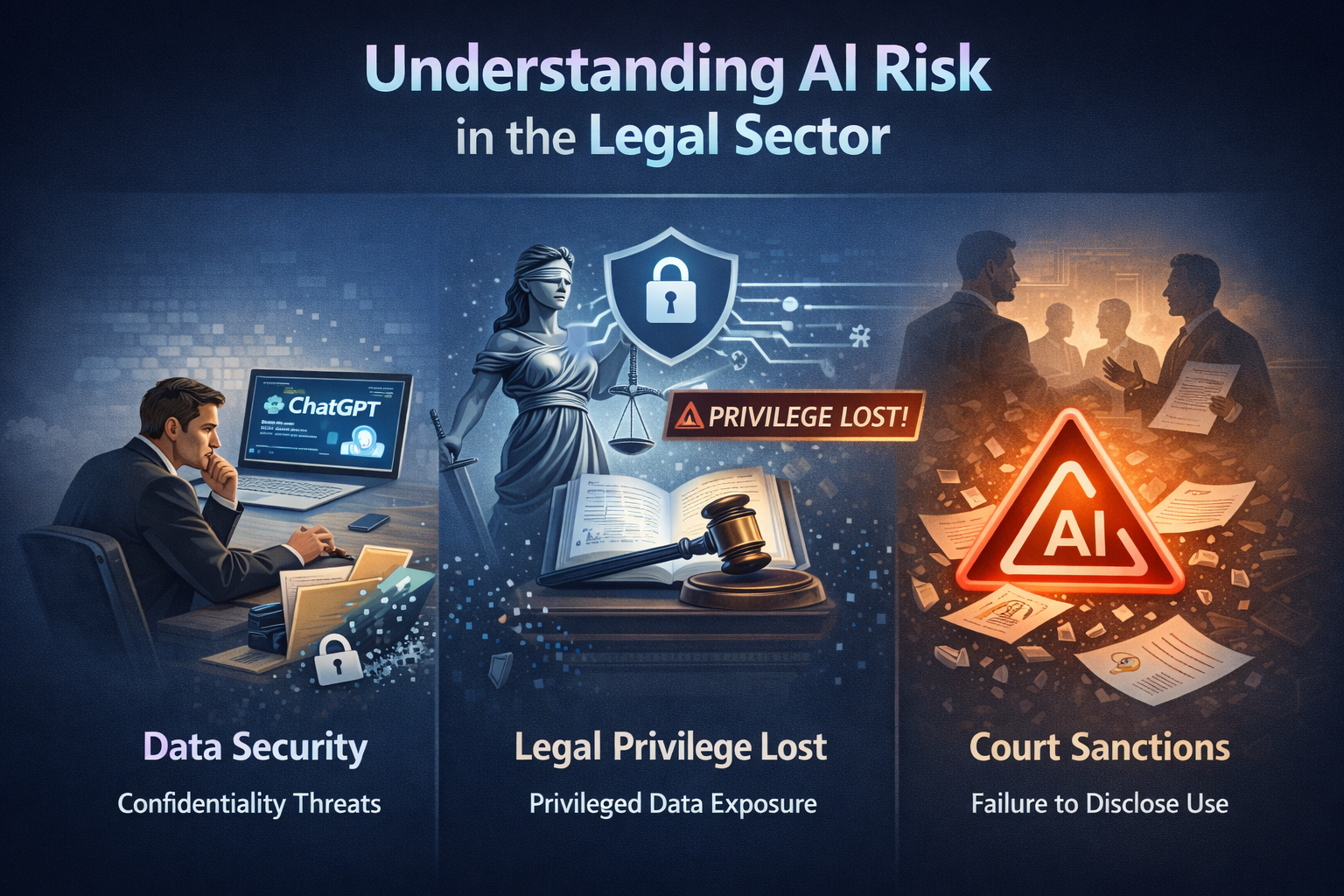
Understanding AI Risk in the Legal Sector
The rapid rise of tools like ChatGPT, Gemini, Copilot, and Grok is changing how legal professionals work. These platforms can draft documents, summarise long texts, and answer complex questions in seconds. But with convenience comes serious AI risk in the legal sector from data breaches to legal privilege issues and even court sanctions.
Law firms can’t afford to ignore these threats. Here’s what AI risk really means for the legal profession and how to manage it safely.
1. Confidentiality and Data Security Risks
The first and biggest AI risk in the legal sector is loss of confidentiality. Many lawyers use generative AI tools without realising that these systems often store or process input data on external servers. When client names, case details, or legal strategies are entered into these tools, that information might not stay private.
Even anonymised data can sometimes reveal identities through context.
2. Losing Legal Privilege Through AI Use
Legal privilege protects confidential communications between lawyers and clients but once data leaves your firm’s control, that privilege could vanish. Public AI tools operate on cloud infrastructure, often in different jurisdictions. Inputting case details into these systems could mean the information is no longer privileged, putting both clients and lawyers at risk.
Protecting privilege is therefore a core part of managing AI risk in the legal sector.
3. Hallucinations and False Legal Information
Another significant AI risk comes from “hallucinations.” AI tools can generate text that looks credible but is completely inaccurate including fake case citations or misapplied laws.
Relying on these unverified outputs can lead to embarrassing mistakes, professional negligence claims, or even fines. Judges have already sanctioned lawyers for filing documents containing AI-invented case law.
4. Transparency and Court Sanctions
Courts are increasingly alert to the use of AI in legal work. Some now require lawyers to disclose whether they’ve used AI in research or drafting. Failing to do so could lead to sanctions or professional discipline.
Managing AI risk in the legal sector means being open about where and how these tools have supported your work and ensuring every AI-generated output is checked by a qualified lawyer.
5. How Law Firms Can Manage AI Risk
AI doesn’t have to be avoided; it just needs to be controlled. To minimise AI risk in the legal sector, firms should:
- Ban the entry of identifiable client data into public AI tools.
- Use enterprise-grade or in-house AI systems with strong data protection commitments.
- Always verify AI drafts, citations, and research before use.
- Train staff on ethical responsibilities and emerging AI regulations.
- Maintain audit trails showing how AI tools were used in each matter.
The Takeaway
AI is here to stay but so are lawyers’ professional duties. Recognising and managing AI risk in the legal sector is now as important as GDPR compliance or data security.
Treat every AI tool like an unqualified assistant: it can help with research and structure, but never with judgment or legal reasoning. With the right policies in place, firms can safely use AI without compromising integrity, confidentiality, or trust. Speak to us today to learn more.